_page-0001.jpg)
There is a call that every NEMT dispatcher knows.
Not the routine ones. Not the driver check-ins or the hospital confirmations.
The other call.
The one that comes in when a patient has been sitting outside for twenty-two minutes.
When the dialysis chair is already waiting. When a family member on the other end of the line isn't angry they're scared.
That call doesn't show up in your KPIs. It doesn't get logged in a report.
But it stays with you.
People outside of NEMT call it logistics.
The people inside it know better.
It is not logistics. It is the daily act of holding someone's medical continuity together with imperfect information, limited vehicles, and a schedule that starts breaking the moment the first driver hits an unexpected roadblock.
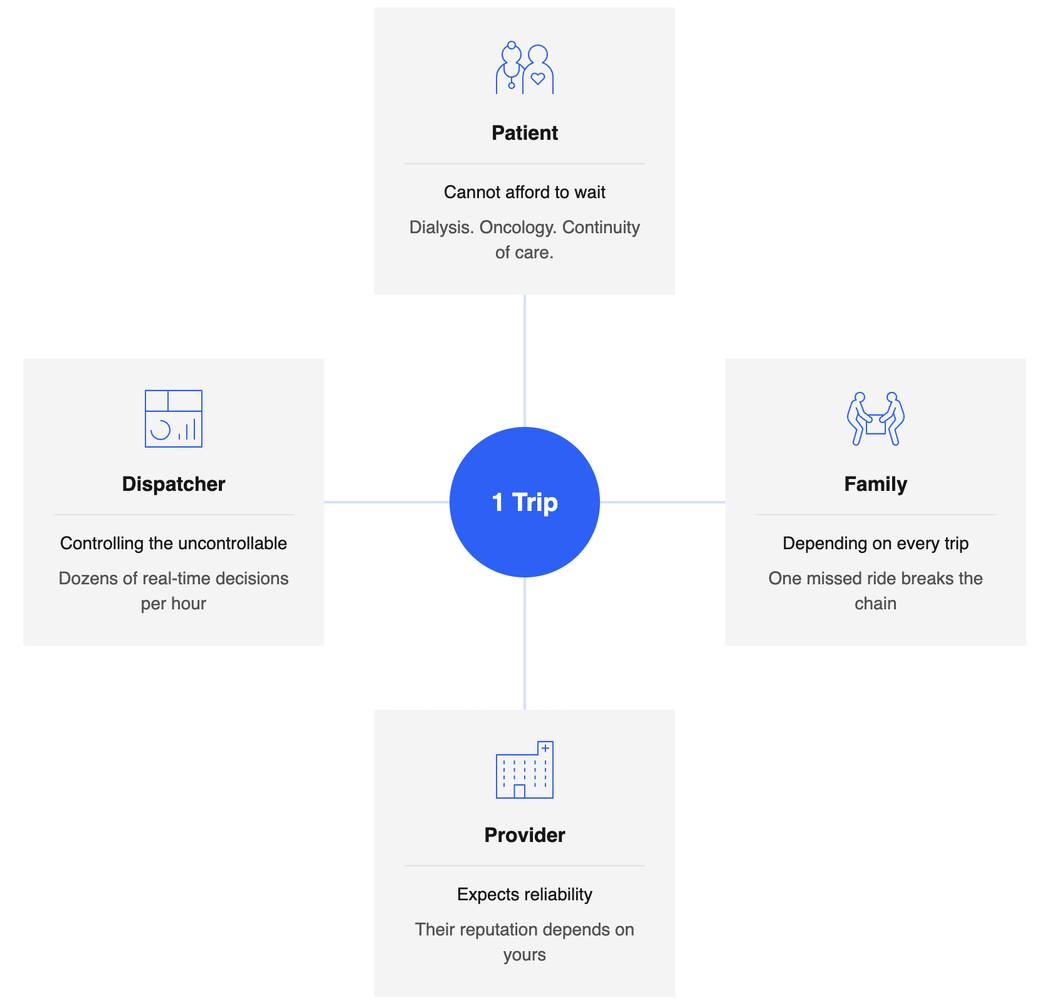
Every single trip carries something heavier than a destination:
A patient who hasn't missed a dialysis appointment in three years and cannot afford to start now. A cancer patient for whom this appointment took six weeks to schedule. An elderly woman whose daughter called twice this morning to confirm the ride, because she has been let down before.
These are not data points. They are people whose entire day sometimes their entire week pivots on whether transport shows up.
And the dispatcher sitting at that screen knows it. Feels it. Carries it.And the dispatcher sitting at that screen knows it. Feels it. Carries it.
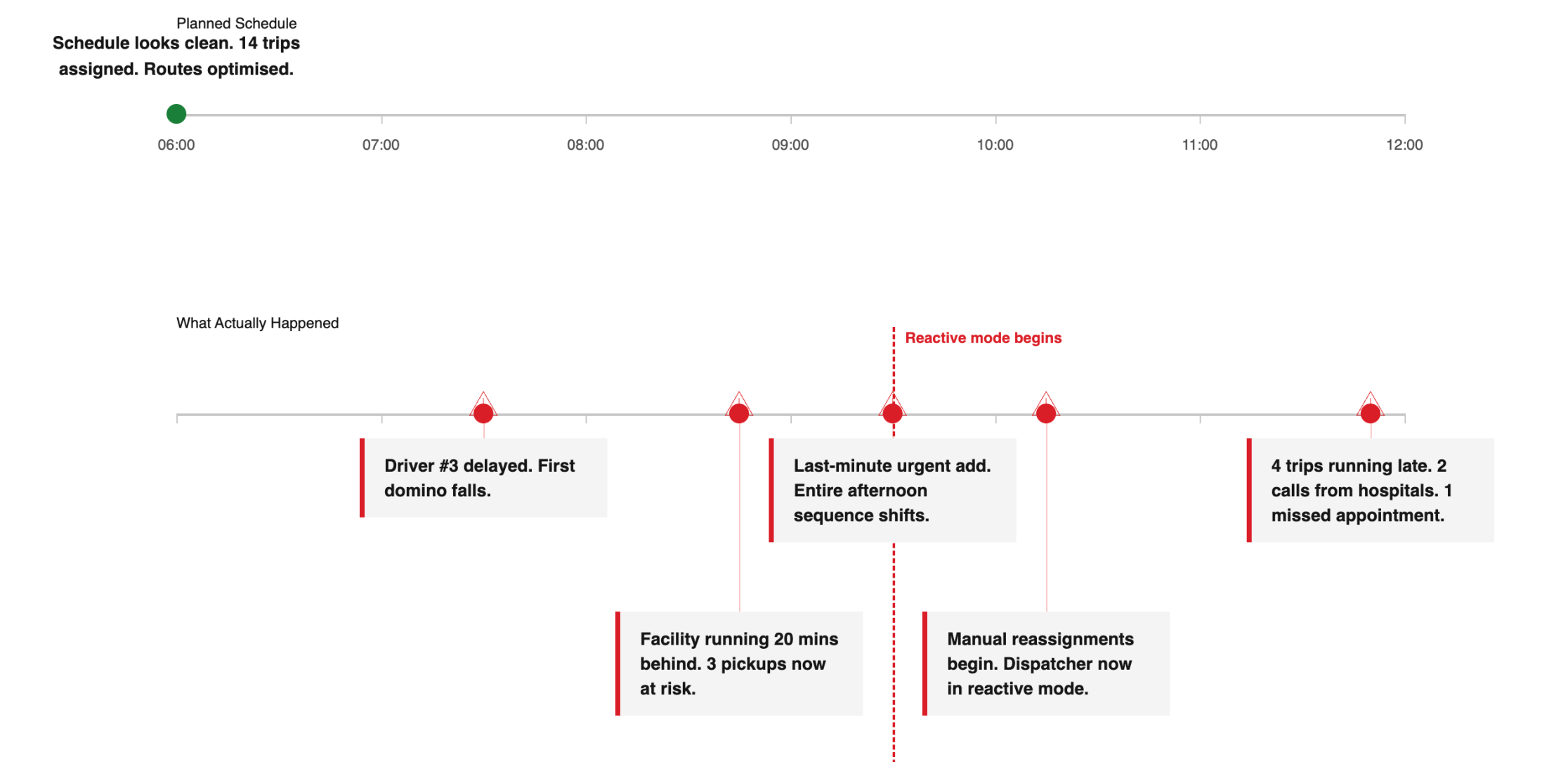
No matter how well the morning schedule is built, it rarely survives contact with the real world intact.
Traffic reroutes a driver by fourteen minutes. A facility runs behind and a patient isn't ready at pickup. A last minute add comes in urgent, non-negotiable and suddenly the entire afternoon sequence needs to shift.
And the dispatcher?
They're already on the phone. Already manually adjusting. Already doing the mental math of who can absorb the delay, which trips have the least margin, which driver is closest but not technically available.
This is not a failure of process. It is not a failure of people.
It is what happens when human beings are asked to make real-time, high-stakes decisions dozens of them, every hour without the tools that match the complexity they're managing.
The result is not chaos. Most teams hold it together.
But holding it together is not the same as operating well.
Here is something the industry rarely admits:
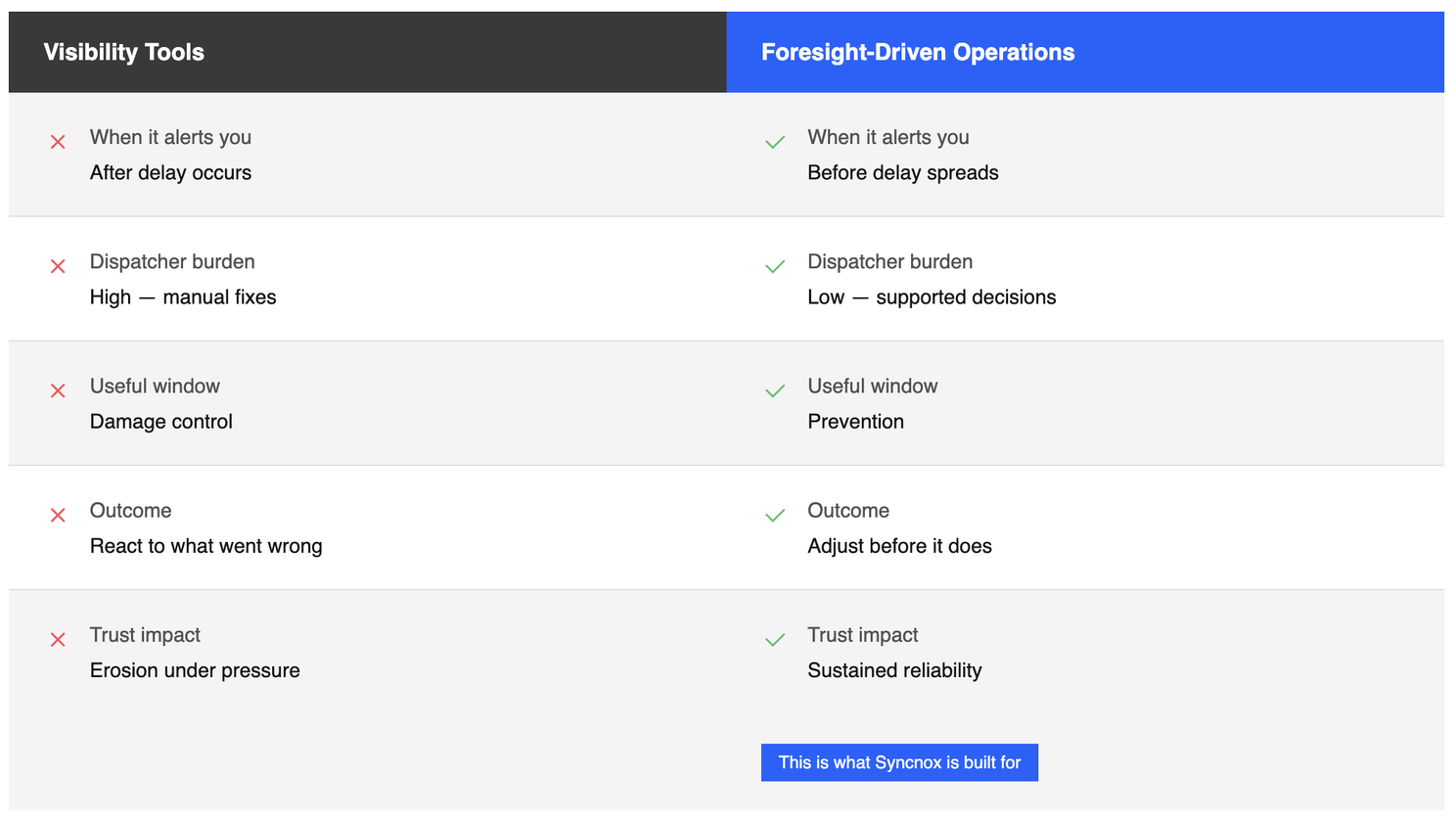
Visibility tools, by themselves, don't solve the problem. They just show you the problem faster.
When a screen tells you a vehicle is running late, the delay has already happened. The downstream consequences the missed appointment, the rescheduled trip, the call to the hospital are already in motion.
What dispatchers actually need isn't a clearer picture of what's going wrong.
They need to stop so many things from going wrong in the first place.
The question that matters isn't "where is the vehicle right now?"
It's "which trips are quietly drifting toward late and what can we adjust before they do?"
That shift from reactive to anticipatory is not a feature request. It is the difference between surviving a day and actually running a sustainable operation.
Every NEMT provider has an on-time rate they track.
But the patients don't see that number. They don't know your monthly average. They don't care about your year-over-year improvement.
What they know is whether the ride came.
Whether they made it to the appointment.
Whether someone somewhere in that chain of coordination kept their word.
On-time performance is really just a number that tries to measure trust. And trust is extraordinarily easy to lose and painfully slow to rebuild.
One missed trip from a patient who has never had a problem before changes everything. They call their case manager. The case manager notes it. The provider hears about it. And suddenly, reliability which took months to build is questioned in a single conversation.
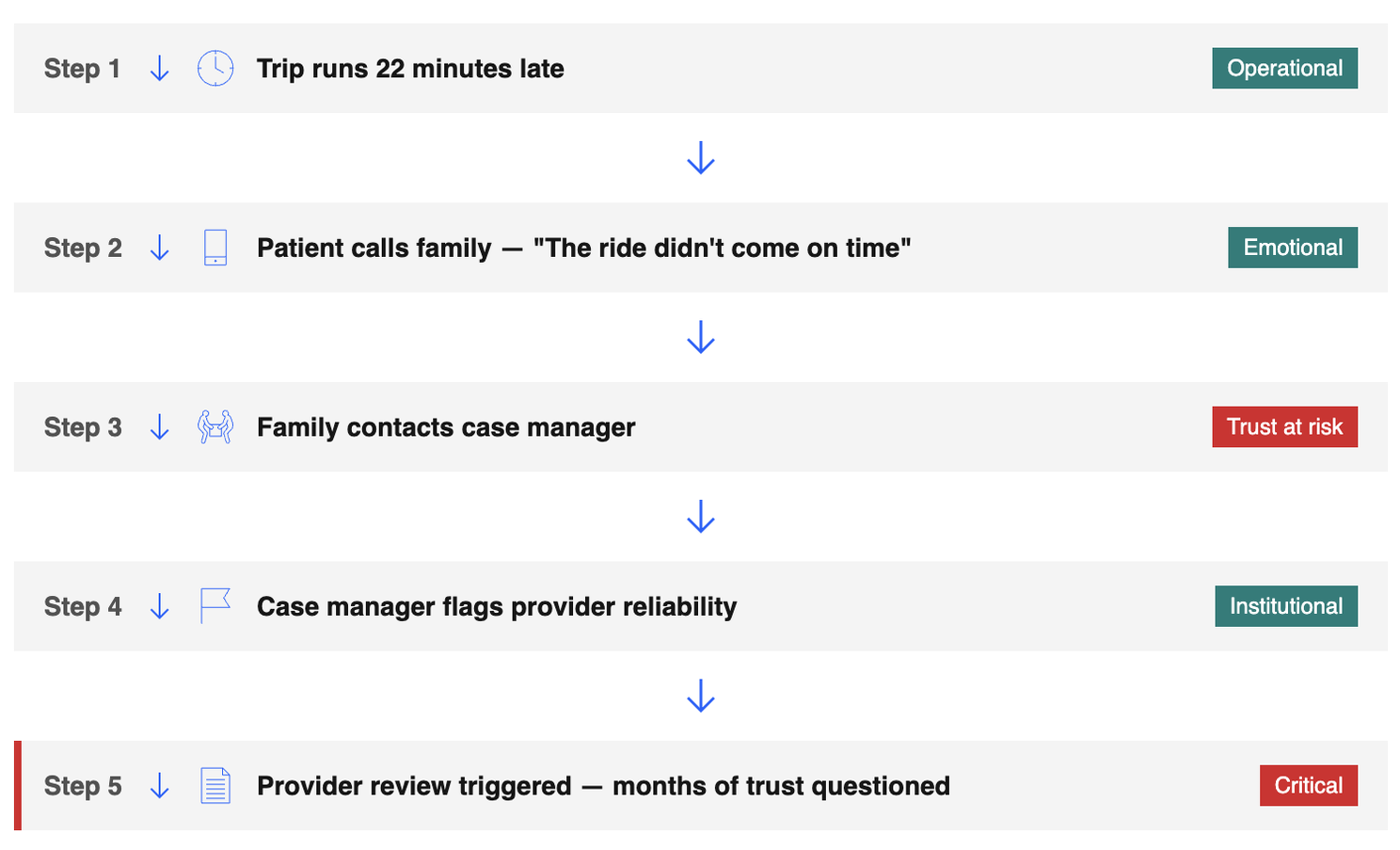
This is why operations that obsess over on-time performance are not being overly cautious. They understand what is actually at stake.
The best-run NEMT operations don't look dramatic from the outside.
There isn't urgency. There isn't the low hum of controlled panic that becomes background noise in overwhelmed dispatch centers.
Drivers know their routes. Adjustments happen early. Dispatchers are making decisions not just reacting to crises.
The phone still rings. Complications still arise. But they are handled at the pace of management, not the pace of emergency.
That calmness is not accidental. It is the result of a system that is designed to surface problems before they become pressures, and to support decisions before the window for good decisions closes.
It is the difference between a team that is in control and a team that is trying to regain control.
Syncnox was built with one central belief:
The burden of complexity should sit with the system not the people.
Dispatchers should not have to hold the entire day's logic in their heads, constantly recalculating, constantly triaging. That cognitive load is not just exhausting it is where good operations quietly break down.
Syncnox is designed to do what good operations actually need: understand how a day is unfolding, identify where risk is building before it becomes visible, and help teams make adjustments while there is still time to make them cleanly.
Not more alerts. Not more screens. Not more noise.
Less friction. Fewer moments where everything depends on one person catching something in time.
When the system is doing more of the anticipatory work, dispatchers can do what they are actually best at using judgment, handling the genuinely unusual, and providing the human layer that no software can replace.
There is a version of this conversation that stays purely operational. Trip counts. Utilization rates. Cost per mile.
Those numbers matter. They keep organizations viable.
But they are not why most people in NEMT came to this work.
They came because transportation simple, reliable transportation is the thing that makes everything else in a patient's care possible. Without it, the appointment doesn't happen. The treatment doesn't happen. The continuity of care that took months to build quietly unravels.
On-time performance, at its core, is an act of care.
Every trip that arrives on time is someone's treatment happening. Someone's appointment kept. Someone's family exhaling instead of panicking.
That is the work.
And it deserves tools that take it as seriously as the people doing it do.
At Syncnox, we build for the operators who carry this weight every day because the patients they serve deserve operations built around prevention, not just reaction.
_page-0001.jpg)
Subscribe to stay on top of new product features, releases, use cases, video chats with experts and learning opportunities.
_page-0001.jpg)
How Dairy Operators can Cut Costs and Improve Freshness
_page-0001.jpg)
Problems hiding inside your field teams
.svg)
To connect with a product expert today, email us or call +44 07454961942.
.png)

.png)
.png)
.png)