_page-0001.jpg)
3 min read · For fleet managers who know something's off but can't yet prove it in a budget meeting
Picture this.
Your truck finishes a commercial round in an industrial estate at the north end of town. Next job?
A residential cluster 7 miles south. Nothing to collect along the way.
That drive is called a deadhead mile. And right now, across your fleet, it's happening dozens of times a day.
Nobody approved it. Nobody logged it as a cost. It exists quietly inside your routing logic, draining diesel, adding driver hours, and wearing out vehicles that were supposed to last another three years.
UK diesel sits at approximately £1.45/litre as of early 2026. A standard waste collection vehicle returns roughly 8 miles per gallon around 82p per mile in fuel alone.
If your fleet runs 30 deadhead miles per vehicle per day across 10 vehicles, that's £246/day in fuel for miles where you collected absolutely nothing ~£89,000 annually, before adding driver labour, vehicle wear, and emissions costs.
AI-optimised routing has delivered 16–18% fuel reductions in comparable fleet operations. On a fleet spending £400,000/year in fuel, that's £64,000–£72,000 back annually without buying a single new vehicle.

Here's the uncomfortable irony: most route optimisation tools are designed to minimise travel time between assigned stops. They're excellent at sequencing jobs you've already given them.
What they don't do is question whether that cluster of stops should be on that vehicle's round today or whether two lighter runs could be consolidated, or whether a job better fits a truck already in that postcode.
They optimise inside the box. They don't redesign the box.
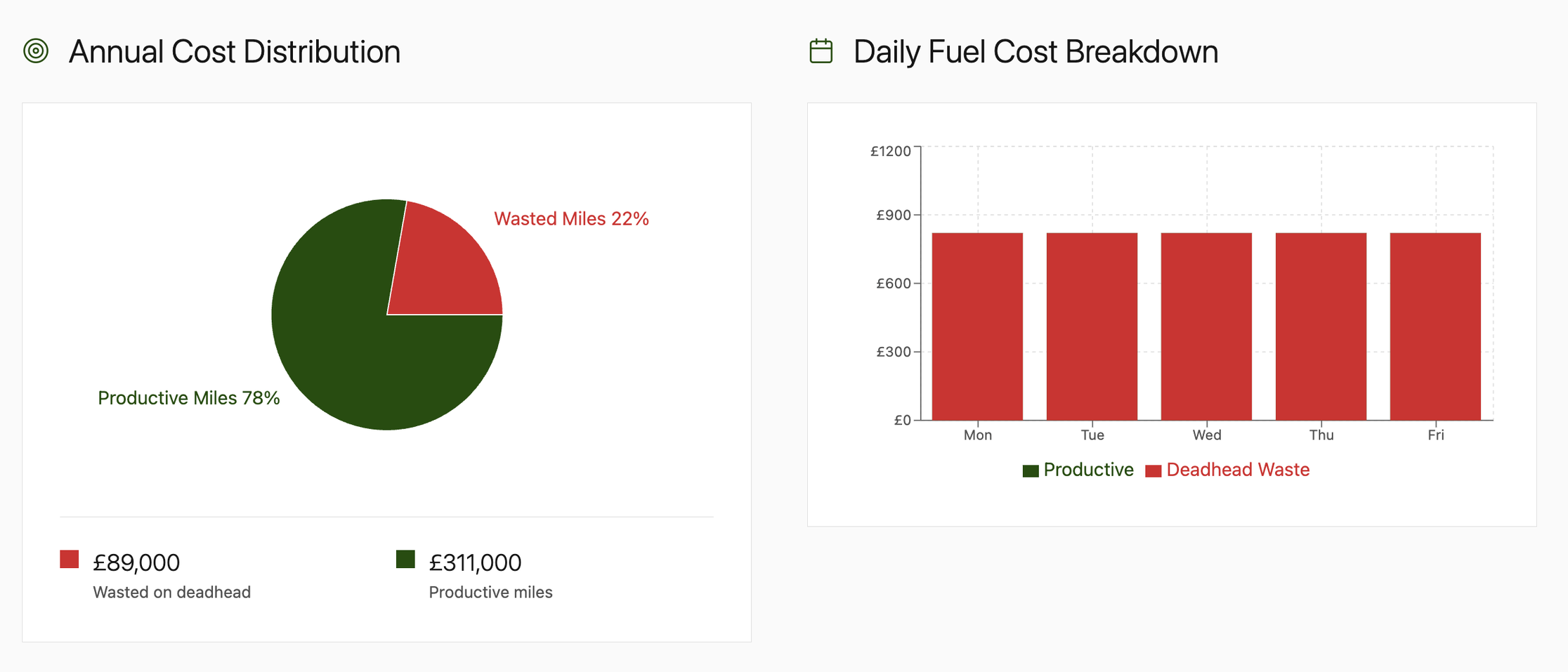
That's the gap. And in a £97.8 billion industry growing under rising fuel costs, carbon reporting pressure, and tighter local authority contracts that gap is expensive.
Ask your depot manager to pull GPS data for three vehicles from last Tuesday. Track every segment where the truck was moving but not collecting. Add up the miles.
Industry benchmarks suggest most unoptimised fleets run 18–28% deadhead mileage as a percentage of total daily distance. If yours is in that range, you now have a number with a pound sign in front of it.
That number tends to get attention in budget meetings.
True route optimisation built on constraint-aware algorithms, not just mapping APIs looks at the full picture: geographic clustering, vehicle proximity, driver shift windows, vehicle capacity, and time constraints simultaneously.

When you eliminate deadhead miles at scale, you don't just save fuel. You recover vehicle capacity, reduce overtime, and often discover you can serve more customers with the same fleet. That's not just efficiency. That's growth.
_page-0001.jpg)
.svg)
To connect with a product expert today, email us or call +44 07454961942.
.svg)

.png)
.png)
.png)