Try Syncnox free for your first 2 months - no credit card required, cancel anytime. →
_page-0001%20(1).jpg)
For twenty years we sold route optimization on fuel savings. Labor became the dominant cost a long time ago. Almost nobody updated the pitch.

A driver doesn't actually quit on Monday.
She quits on the third Friday in a row when the dispatcher pushed two extra stops at 4:47 PM, the optimizer cheerfully routed her through a downtown that has zero parking and a personality, and she pulled into the yard at 8:30 PM for the fifth time this month.
Somewhere around stop 27, while idling behind a Sysco truck blocking an entire alley, she opened LinkedIn on her phone.
The resignation email arrives Monday at 9:14 AM. It is polite. It is short. It does not mention the route. By Wednesday, you are paying somewhere between $8,000 and $15,000 to replace a driver who would have stayed if the route had simply been honest with her about what the day was going to be.
This is what route optimization actually costs when you measure it wrong. And almost the entire industry is measuring it wrong.

Pull up your last twelve months of P&L and find the line for Fuel & Mileage Savings From Route Optimization. Now find the line for Recruiting & Replacement Costs From Driver Turnover.
If your books are honest, the second number is between three and ten times bigger than the first.
Here is the part that should make a CFO put down their coffee. The U.S. commercial driver shortage is sitting at roughly 82,000 unfilled positions in 2026. Replacing one driver costs $8,000 to $15,000 before that driver completes a single delivery. Voluntary turnover in trucking still hovers at 90 to 94 percent annually.
More than 60 percent of drivers, when surveyed about why they quit, point to inefficient routes and overwork. Every empty seat costs the fleet roughly $3,000 to $5,000 per month in lost productivity until it is filled.
Multiply those numbers by the size of your fleet. Sit with the result for a minute. Most ops leaders, when they finally do this math, discover that they have been celebrating a 4% fuel savings while bleeding 11% of their margin out the side door.

The fleet that figures this out first will quietly poach everyone else's drivers for the next five years. The fleets that don't will spend that same five years writing checks to recruiters and blaming "the labor market."
When a software vendor asks a driver "is this a bad route?" and the driver says yes, the vendor usually thinks the answer is "it's longer than necessary."
That is almost never what the driver means.
Drivers can handle long. Drivers can handle hard. What drivers cannot handle, and what eventually pushes them out the door, is unfairness disguised as math.
The optimizer sees miles. The driver experiences indignity, fatigue, and the slow-burn realization that nobody designing the route is on her side.

For twenty years, route optimization has been sold on a single promise: shorter routes, lower fuel costs.
That promise made sense when fuel was the dominant variable cost in fleet operations.
Fuel is not the dominant variable cost anymore. Labor is. And labor is becoming more expensive, harder to find, and harder to keep, every quarter.
Which means the entire category of route optimization software needs to be re-evaluated against a new question. Not how much fuel did this save? but how much of my workforce did this preserve?

The companies that figure this out first will take the labor advantage in a market where everyone else is hemorrhaging drivers and pretending the problem is "the labor market."
The labor market isn't the problem. The labor market is the symptom. The disease is that most fleets are still optimizing for an objective function that ignores the human in the cab.

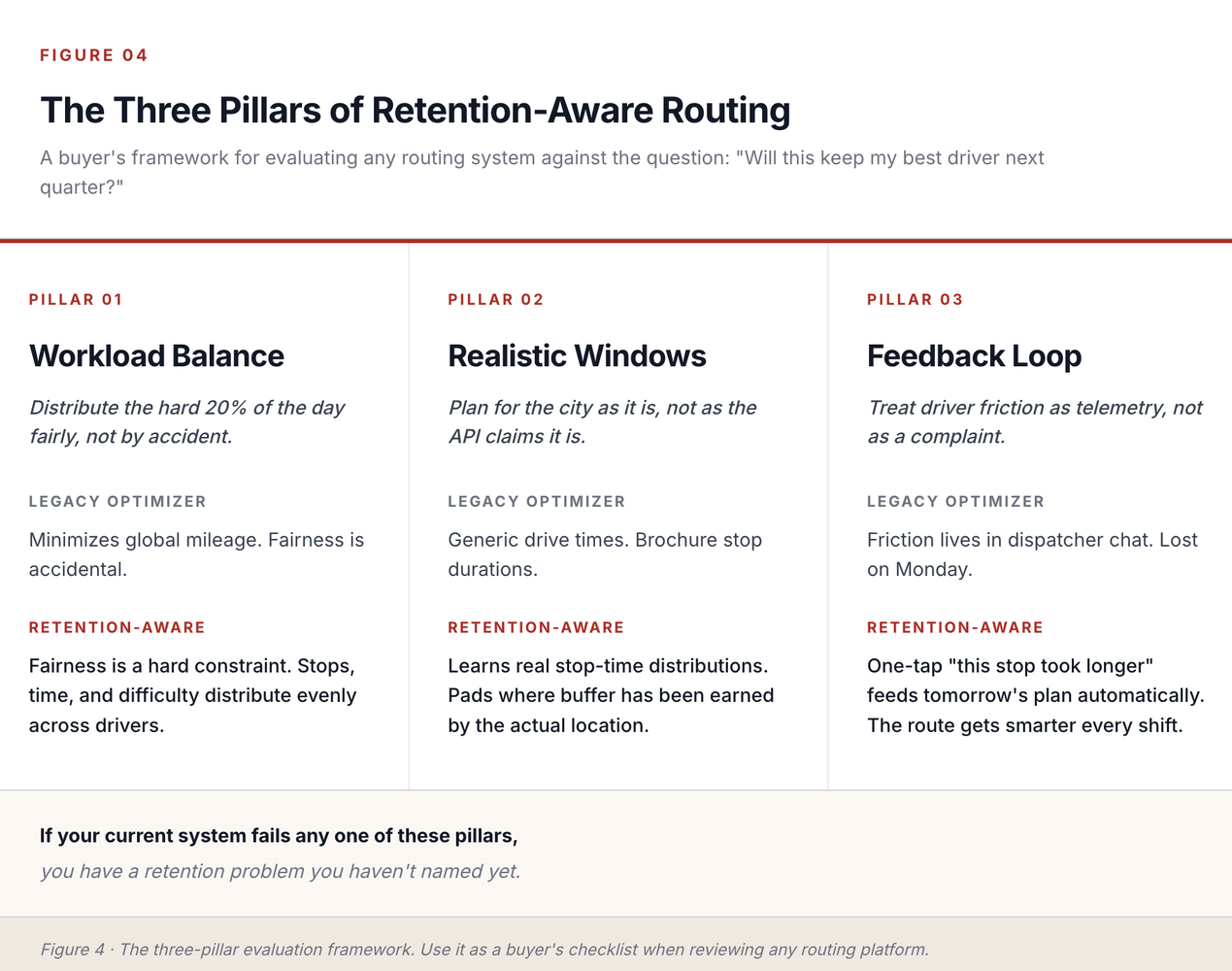
A routing system that takes retention seriously does three things that legacy systems either don't do or do badly.
1. It balances workload across drivers, not just minimizes total miles. The classic optimizer treats the fleet as one giant shared pool and assigns stops to whichever truck makes the global mileage smallest. That math is elegant. It is also the fastest way to make your strongest driver quit, because she will consistently end up with the hardest twenty percent of the day. A retention-aware optimizer adds fairness as a constraint, not as a side note in the user manual.
2. It plans for reality, not for theoretical drive times. Google's drive times are an average across all drivers and all conditions. Your driver is one person, in one truck, on one day, in a city she actually knows. Retention-aware routing learns the real stop-time distribution at every customer not the brochure number and pads the day with buffer where buffer has been earned.
3. It treats driver feedback as a data source, not as a complaint. When a driver flags that "this complex eats forty minutes, not eight," that is not whining. That is the most valuable telemetry in your operation. A retention-aware system feeds that signal back into tomorrow's plan automatically. A legacy system loses it the moment the dispatcher closes the chat window.
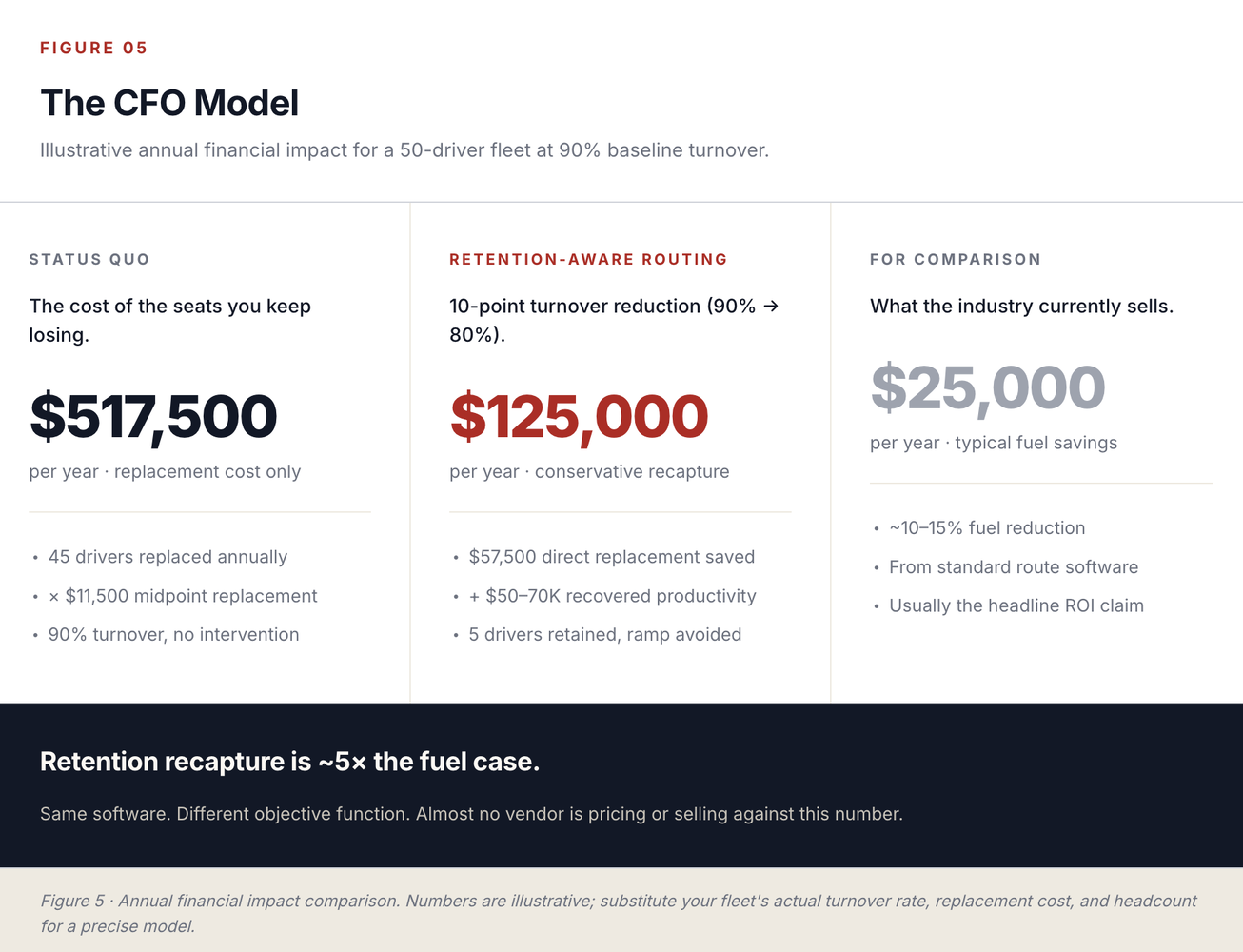
Take a fifty driver fleet running at the industry-average 90 percent annual turnover. That is roughly forty-five drivers replaced per year. At a midpoint replacement cost of $11,500, that is $517,500 a year just to keep the seats warm.
Now reduce voluntary turnover by ten percentage points from 90% to 80%. That is five drivers retained. That is roughly $57,500 in direct replacement cost savings, plus another $50,000 to $70,000 in recovered productivity from not having seats sit empty during ramp-up. Call it $125,000 a year, conservatively, on a fifty driver fleet.
For comparison, the same fleet might save $20,000 to $30,000 a year in fuel from a typical route-optimization deployment.
The retention case is roughly four to five times the fuel case. Almost nobody is selling it.
These are not exotic outcomes. They are what happens when you stop treating routing as a math problem and start treating it as the operational backbone of your retention strategy.

If your routing software has been graded purely on miles saved per quarter, you have been measuring the wrong thing for the entirety of its contract.
The right question isn't how much fuel did the optimizer save us last month?
The right question is: Which of my best drivers is currently three bad Fridays away from updating her LinkedIn and what is my routing system doing, or not doing, about it?
The fleets that learn to answer the second question are going to spend the next five years quietly poaching everyone else's drivers.
The ops directors who can't answer it are going to spend the same five years writing checks to recruiters and wondering why the labor market is "so tough this year."
The labor market is fine.
Your routing might not be.
_page-0001.jpg)
.svg)
To connect with a product expert today, email us or call +44 07454961942.